
Get An Offer Today, Sell In A Matter Of Days
We buy rowhomes for cash across Kensington, East Kensington, West Kensington, Olde Kensington, and Harrowgate — as-is, no fees, no commissions, no repairs, with a fair offer within 24 hours and a closing date you pick. And because this neighborhood’s market is unlike any other in Philadelphia right now, here’s what a Kensington owner deserves to know before selling to anyone.
The new assessments hit Kensington hardest
When the city released its newest property assessments in summer 2026 — the values that will set tax-year-2027 bills — Kensington’s median assessment jumped 15.3%, from $115,700 to $133,400. That was the steepest increase of any neighborhood in Philadelphia, worth roughly $250 more per year on a median home, and city officials tied it partly to outside speculators betting on the neighborhood.
Before that number pushes you into any decision, know the free relief programs — they matter here more than almost anywhere:
- The Homestead Exemption knocks $100,000 off the assessed value of an owner-occupied home — on Kensington’s median assessment, that shields most of the value and saves an average of about $1,400 a year.
- LOOP (Longtime Owner Occupants Program) can cap the bill if you’ve owned and lived in your home 10+ years and your individual assessment spiked 50% or more in a year. This year’s application deadline is September 30, 2026.
Apply for what you qualify for even if you think you might sell — a lower bill costs you nothing while you decide. If you do sell, a cash offer from us is a parallel option, not a last resort: it prices the “sell as-is” column while the relief programs price the “stay” column.
Two markets on the same block
Kensington is where Philadelphia’s price extremes stand wall to wall. Redfin’s Kensington-proper area shows a median sale price around $147,000, while its East Kensington area — a few blocks toward Frankford Avenue — runs around $345,000, and Fishtown higher still (spring 2026 figures). New construction, much of it still riding tax abatements from the late-2021 permit rush, rises next to two-story workers’ rowhomes that have not seen a major renovation in fifty years.
The investor pressure behind that is documented: the Inquirer found that from 2020 to 2022, more than half of single-family purchases in upper Kensington were made by corporate entities — roughly double the citywide share — and that owners holding 20-plus parcels control about one in five properties there. None of that is a reason to panic-sell. It is a reason to check out any buyer who contacts you, ask who is actually purchasing the house, and get a property-specific number instead of a ZIP-code guess — on blocks like these, the difference is tens of thousands of dollars.
Workshop-of-the-World houses, a century and a half on
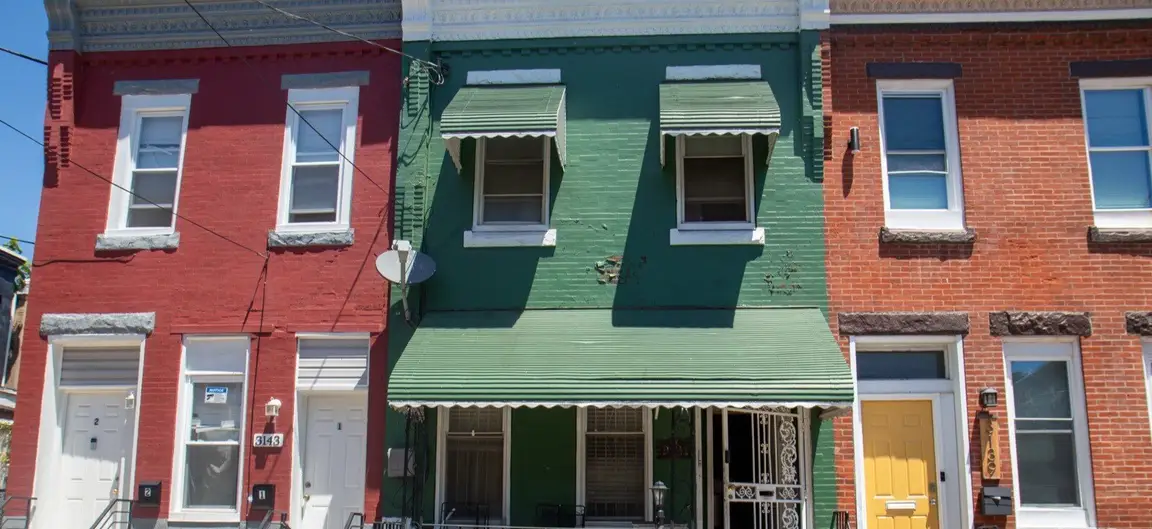
Kensington predates the United States — English merchant Anthony Palmer laid out his riverfront town in the 1730s and named it for the London district. It even governed itself as the Kensington District from 1820 until Philadelphia absorbed it in 1854. But the blocks you own were built for mill workers. The ingrain carpet industry took root around Oxford and Howard Streets in the 1830s–1850s, and by 1928 Kensington held 350 of Philadelphia’s 850 textile firms. The housing that filled in around the mills — two-story brick rows, plus mid-block trinities as small as 400–600 square feet — is now 100 to 160 years old. Some of it has been beautifully rebuilt; the Coral Street Arts House in East Kensington turned an 1886 National Register textile mill into 27 artist apartments. And some of it needs everything: roofs, joists, wiring, plumbing — the repair bills that stop a conventional listing cold.
Long-vacant houses sit in the mix too. The city has sealed hundreds of vacant properties in upper Kensington in recent years and now tracks remediation on a public Kensington dashboard launched in March 2026. Owning a vacant Kensington property carries real obligations — if that’s your situation, it deserves a plan, not just a padlock.
A clean sale, whatever the block
Tell us about the property — call or text (215) 515-7799 or use the form. Fair cash offer within 24 hours, no fees, no commissions, no repairs, no cleanout, and you choose the closing date. We’ll walk you through the number line by line, and if listing with an agent would genuinely net you more, we’ll tell you that too.
This page is general information about selling a house in Kensington — not legal or tax advice. Program rules and deadlines change; confirm details with the City of Philadelphia or an attorney.
Want a real, property-specific number for your Kensington rowhome? Request your free cash offer here, or call or text (215) 515-7799.
Frequently asked questions
My Kensington assessment jumped. Does that mean I should sell?
Not by itself. Check the Homestead Exemption and LOOP first — for many longtime owners they blunt most of the increase, and applying costs nothing. Selling makes sense when the house itself no longer fits your life: repairs you don’t want to fund, a rental you’re done managing, an estate to settle. We’ll give you a free offer so you can compare both paths with real numbers.
Investors keep calling and texting about my house. How do I know who’s legitimate?
Ask two questions: “Are you buying it yourself or assigning the contract?” and “Are you licensed?” Philadelphia requires residential wholesalers to hold a city license and give you a written disclosure days before you sign. We’re direct buyers — ask us anything on that list, and take your time checking the answers.
Do you buy the small trinity-style houses and homes that need major work?
Yes. Trinities, two-story mill rows, fire damage, failed roofs, knob-and-tube — we buy Kensington houses in exactly the condition they’re in and price the work honestly into the offer. No contractor quotes, no cleanout, leave what you don’t want.
How fast can you close on a Kensington rowhome?
A fair cash offer within 24 hours and closing in as little as two weeks. If you need longer — an estate, a move, a tenant transition — you pick the date and we work around it.